

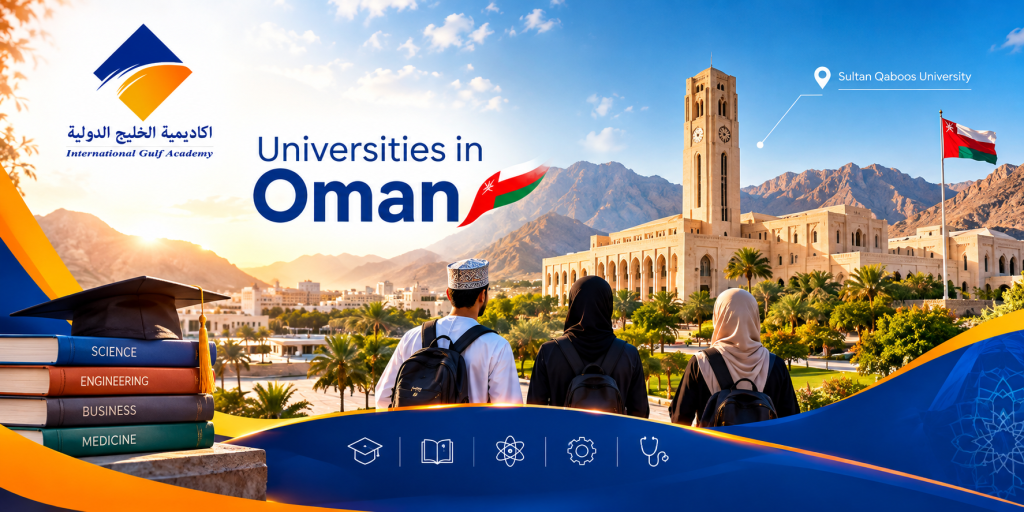

Higher Education in the Sultanate of Oman
Higher education in the Sultanate of Oman encompasses three academic levels: Bachelor’s, Master’s, and Doctoral degrees. The primary focus is on enhancing the quality of education and advancing knowledge and technology to achieve sustainable development objectives.
Oman’s education system places significant emphasis on improving the quality of education and research, developing practical skills, and nurturing a talented and capable workforce. Academic programs offered by universities in the country are designed in accordance with the needs of the labor market as well as local and global communities.
In the Sultanate of Oman, 25 universities and educational institutions provide international students with educational services across a wide range of fields and specializations, including medicine, engineering, business and administration, technical disciplines, foreign languages, and the humanities. Admission to these institutions requires applicants to submit the academic certificates corresponding to their previously completed level of education to the respective university.
Best Universities in the Sultanate of Oman
Choosing a university for further education in Oman can be a challenging decision for any Iranian student. The country is home to numerous international universities, many of which are branches or affiliated institutions of universities from the United States, Australia, and Europe. Students often have important questions when considering studying in Oman: Why Oman? Which universities in the country offer degrees with greater academic value and recognition? What facilities and equipment do they provide? Ultimately, which university in Oman should they choose for their studies? What are the admission requirements for each institution? And more.
In the following sections, we have attempted to answer these questions. So, stay with us.
Note: To learn more about the admission and registration requirements, available academic programs, tuition fees, facilities, and required documents for each of these universities, you can contact the specialized advisors of Al-Khaleej International Academy Oman in Iran. These advisors will support you throughout the entire process—from selecting an academic field and obtaining admission to securing a visa, arranging accommodation, and accessing other services required by students in Oman. They can also monitor your academic performance and follow up on your educational progress through to graduation.
Higher Education in Oman
Higher education in Oman is divided into two main sections: university education and vocational training. Due to the need for specialized professionals, the Omani government places greater emphasis on vocational education. However, social patterns indicate that most young Omanis are not interested in skill-based jobs.
Bachelor’s Degree
Within Oman’s education system, a Bachelor’s degree program generally takes approximately five years to complete. The first year is dedicated to English language, mathematics, and IT training through the General Foundation Program (GFP). The second year focuses on scientific subjects relevant to each academic discipline, while the remaining three years are dedicated to the core courses and specialized subjects of the chosen field of study.
Admission to Bachelor’s degree programs at Omani universities requires a 12-year high school diploma. Admission to some universities in the country is conducted through entrance examinations. Students who wish to study at universities offering free education are required to take these examinations, which primarily cover IT, mathematics, and English language as part of the GFP, and achieve the required minimum score.
International students applying for Bachelor’s degree programs are required to provide proof of English-language proficiency with a minimum IELTS score of 5.5.
Master’s Degree
Master’s degree programs at universities in Oman generally take approximately two years to complete. Students may pursue their studies on a full-time, part-time, or online basis.
Students seeking admission to a Master’s program at Sultan Qaboos University in Oman must obtain a required score ranging from 2.75 to 4 in the university’s GFP examination. In addition, an IELTS score of 6.5 is required for admission to this level of study.
Among the documents required for pursuing a Master’s degree in Oman is a translated copy of the applicant’s Bachelor’s degree certificate.
Doctoral Degree
Admission to Doctoral programs at universities in Oman requires a strong academic and research profile. Applicants are required to submit a Master’s degree, preferably with a high GPA, along with their academic credentials from previous levels of education.
In addition to a strong academic record, applicants generally need an IELTS score of 7, reputable ISI-indexed publications, and the introduction or identification of a supervisor or academic advisor.
Doctoral programs are generally conducted in English and typically require approximately two to four years to complete. During this period, students participate in various academic research projects and seminars.
Education of International Students in Oman
In the Sultanate of Oman, international schools have been established to provide education for non-Omani and foreign students. These schools are generally attended by the children of employees of Omani non-governmental organizations, diplomats, and executives of multinational companies. The educational curriculum of these schools is generally aligned with that of government schools, with the main difference being, perhaps, the language of instruction, which is English. The owners and founders of these schools are Omani nationals, and their minimum educational qualification is generally at the secondary-school level.
Education at international schools in Oman is not free of charge and requires the payment of tuition and educational fees ranging from OMR 3,000 to OMR 12,000. More specifically, Cheltenham Muscat, the British international school in Oman, charges approximately OMR 4,000 to OMR 8,000 in tuition fees; The American International School of Muscat (TAISM) charges approximately OMR 5,000 to OMR 11,000; ABA Oman International School charges approximately OMR 5,000 to OMR 10,000; and Muscat International School charges approximately OMR 3,000 to OMR 6,000. These schools provide students with a wide range of educational, recreational, and welfare facilities and services up to the age of 18.
- Why Choose Universities in Oman?!
- All leading universities in Oman offer high-quality educational facilities and excellent career opportunities compared with other countries in the Middle East. In addition, they provide a range of advantages, the most important of which include:
- Strong Academic Reputation
- Leading universities in Oman have a strong academic track record and, by employing experienced and specialized faculty members, provide education in fields and subjects relevant to the labor market using the latest international teaching methodologies.
- Diverse Academic Programs
- The academic programs offered by leading Omani universities cover a wide range of disciplines. Students with different interests and preferences can choose their desired fields of study at the Bachelor’s, Master’s, and Doctoral levels and continue their academic education in Oman with confidence.
- Recognized Academic Degrees
- Most universities in Oman enjoy considerable academic recognition within the Gulf region and at the international level, particularly institutions that are directly affiliated with universities in the United States, Europe, and Australia and operate as their official branches in the Arab region.
- Easy University Admission
- Student visas for international students in Oman are generally issued conveniently and within a relatively short period, making the admission and relocation process easier for foreign students.
- Affordable Costs
- Tuition and living expenses in Oman are relatively lower than in many other Arab countries. Students can also access well-equipped university accommodation and a wide range of welfare and support facilities with relative ease.
- Access to Modern Educational and Research Facilities
- Higher education institutions in Oman are equipped with modern educational and research facilities, including advanced laboratories, extensive libraries, research centers, and innovative educational technologies, providing students with access to up-to-date academic and research resources.
- Opportunities for Further Study at Leading Universities Worldwide
- Most universities in Oman maintain extensive academic, technical, and professional collaborations with leading institutions in the United States, Europe, and other parts of the world. Through these cooperation agreements, students have access to opportunities for student and faculty exchange, joint research projects, and the latest scientific findings. Following graduation, students in Oman can also benefit from numerous opportunities to continue their education at prestigious universities outside the country.
- Focus on Practical Skills Development
- In addition to theoretical education, leading universities in Oman place particular emphasis on practical and applied skills. This approach enables graduates to develop the knowledge and competencies necessary to enter the labor market with greater confidence and preparedness.
- Exposure to Different Cultures
- The presence of students from various countries at leading Omani universities provides an excellent opportunity for students to become familiar with different cultures and languages and experience life in a multicultural academic environment.
- Exceptional Geographical Location
- Oman’s strategic coastal location in the Gulf region, together with its remarkable natural resources, numerous historical and archaeological sites, and diverse recreational destinations, offers students a wide range of opportunities to enjoy their leisure time and gain new experiences.
- Proximity to Iran
- Oman’s geographical proximity to Iran is a significant advantage for Iranian students. Lower travel costs, combined with the relative ease of obtaining visas and the possibility of family members and friends visiting Oman, can make the challenges of studying abroad more manageable. For these reasons, Oman represents an attractive destination for Iranian students, offering numerous opportunities, experiences, and discoveries.
- Omani Hospitality
- Omanis are widely renowned for their hospitality. The warm welcome extended by the people of Oman to international visitors from different nationalities, particularly Iranians, combined with the country’s political and social stability, modern infrastructure, and ongoing development, has contributed to making the Sultanate of Oman an attractive environment for international students.
Facilities and Services at Universities in Oman
Universities and higher education institutions in Oman provide international students with a wide range of benefits, advantages, and facilities. These may include scholarships, as well as well-equipped student dormitories or accommodation facilities prepared and available for both male and female students.
Note: At Al-Khaleej International Academy, a comprehensive range of educational and training programs is provided in the best possible manner, tailored to the needs and requirements of applicants from around the world. These students primarily include qualified personnel from government and private sectors, as well as human resources from ministries, institutions, companies, and banks. At the Academy, they acquire the necessary skills through training provided by an experienced and specialized academic team and under the supervision of highly qualified trainers and advisors. This enables them to perform with greater efficiency and productivity within their organizations or successfully enter the labor market.
Best Public Universities in Oman
Universities and higher education institutions in Oman are either public institutions or affiliated with non-profit organizations or private, for-profit organizations. All of these institutions, regardless of their type, operate under the close supervision of the Omani Ministry of Higher Education. This oversight has contributed to the development of high-quality higher education in Oman in line with international standards and has helped create a promising future for researchers, academics, and intellectuals.
Furthermore, this diverse institutional structure enables different segments of society to choose a university according to their financial resources and capabilities and pursue higher education under suitable conditions.
How to Obtain a Student Visa in the Sultanate of Oman
For several years, studying in Oman has become a popular option for students and schoolchildren from around the world, particularly Iranians.
If you are also planning to immigrate abroad and continue your education in Oman, it is advisable to review the requirements for obtaining a student visa in this country.
In general, the requirements for obtaining an Omani student visa vary depending on the applicant’s country of origin. This type of visa is usually issued for a period of six months and can be extended.
The most important documents and requirements for obtaining a student visa to study at universities in the Sultanate of Oman include:
- A certificate confirming completion of 12 years of education, in any field of study (Mathematics, Experimental Sciences, etc.), officially recognized in the country of origin and duly equated by the Omani Ministry of Education. The official Arabic translation of this certificate must be certified by the Ministry of Foreign Affairs and the Embassy of Oman in Iran.
- A copy of a passport valid for at least 6 months, or a residence card (if residing in Oman).
- Four recent 3×4 cm photographs.
- A health certificate approved by the Omani Ministry of Health.
- Admission and pre-registration.
- Obtaining the student visa and insurance.
- Final registration and in-person enrollment.
- If the student holds a residence card in Oman, a copy of the commercial registration (CR), together with the residence card, photographs, and the specimen signatures of the parents under whose sponsorship the student has obtained residence, must be provided.
- A No Objection Certificate (NOC) from the parents confirming their consent to the student’s education, issued in Arabic and certified by the relevant embassy and the Omani Ministry of Foreign Affairs.
- Completion of the General Foundation Program (GFP), or its equivalent, by the student. Students who do not have a GFP certificate or an equivalent qualification may take a placement test. The placement test assesses proficiency in English, Mathematics, and IT.
- An official university letter. In this case, the university acts as the sponsor of the international student and assumes responsibility for the student and the validity of their documents.
Scholarships and Funding Opportunities in Oman
Funding is a form of financial assistance provided to students based on their needs by government organizations, charitable institutions, or universities. This financial support may either be paid directly to the student or provided in the form of a reduction in tuition fees and educational expenses.
Today, many people are interested in continuing their education at a university abroad by obtaining academic funding, scholarships, financial assistance, or through student employment, with the aim of covering part or all of their educational expenses in a foreign country. If you are also planning to continue your studies in your desired field and academic degree at a foreign university by taking advantage of educational funding opportunities, but are not familiar with the process of obtaining academic funding, continue reading this article with Al-Khaleej International Academy.
What Is Educational Funding?
Some international students who meet the necessary requirements may apply for scholarships, financial assistance, or funding provided by the government, university, or educational institution of the destination country, even before receiving university admission and a student visa for that country.
Most funding opportunities are available for postgraduate levels, including Master’s, Doctoral (PhD), and Postdoctoral studies, and their number is limited. This means that, due to the priority often given to domestic students and the limited number of such scholarships and funding opportunities, competition for obtaining them is very high.
However, it should be noted that, depending on the destination country and the university concerned, funding opportunities may also be available for undergraduate studies.
Therefore, given that the evaluation of funding applications can be time-consuming, you should apply for this financial assistance as soon as possible, preferably before applying for a student visa.
Types of Educational Funding
The types of educational funding vary across different countries and universities. Some of the most common types are outlined below:
- Scholarships
Scholarships are the most common type of financial assistance awarded to students to support their continued education. One of the most important advantages of scholarships is that, unlike student loans, students are not required to repay them. Scholarships are offered to students in various forms, including:
Merit-Based Scholarships:
This is the most common type of scholarship, awarded by universities to outstanding students who demonstrate excellent academic and overall qualifications, including high grades, research papers, participation in prestigious conferences, language proficiency, and other achievements.
Athletic Scholarships:
These scholarships are awarded to high-achieving students in various sports, particularly in countries where college athletics play an important role in their culture and society.
Targeted Scholarships:
These scholarships are awarded based on a specific objective, which may involve educational development or the acquisition of specialized knowledge. They are provided to students who can contribute to achieving that particular objective.
Fellowships Offered by International and Independent Organizations:
Fellowships are primarily intended for doctoral students and graduates, although they are sometimes also awarded to outstanding Master’s students. This type of funding is allocated for research on a specific subject and is awarded to individuals who are able to focus full-time on research in a particular field alongside their studies. Obtaining a fellowship is not easy, and applicants must demonstrate the credibility and value of their research. A strong academic record, an acceptable GPA, and participation in an interview are among the requirements for obtaining this type of funding. Students who successfully receive fellowship funding gain considerable academic and professional recognition.
- Student Loans
Student loans are another type of educational funding provided by banks and financial institutions to domestic and international students. After a specified period, students are required to repay the borrowed amount to the lending institution. These loans generally involve banking interest and charges, and delays in repayment may result in financial and other difficulties for students. The most favorable student loans are generally low-interest loans offered by government banks and financial institutions, as they typically provide more flexible repayment conditions.
- Student Grants
Another form of educational funding is a Student Grant, which is provided based on the student’s financial need and does not have to be repaid. Therefore, these grants are generally awarded to students who have very limited financial resources and face significant financial difficulties. The amount of this type of funding varies depending on the relevant organization, university, and the student’s circumstances. For example, within the European Union, such grants may range from €150 to €1,000 per month.
- Self-Funding
Another type of educational funding is self-funding, which means that the student personally covers all educational expenses. In other words, a self-funded student does not receive financial assistance from any organization and is responsible for all tuition and related costs. In such circumstances, students may seek part-time employment during their studies to help cover their expenses while continuing their education.
- Financial Support from Family
One of the most accessible and readily available sources of financial support for students is financial assistance provided by their father, mother, or other family members, which may continue throughout the student’s educational program. In this case, the student’s financial sponsor provides the university and the embassy of the destination country with the required financial documents, such as a bank statement or proof of sufficient funds, to demonstrate that the student has the financial capacity to cover tuition fees and living expenses in that country.
How to Obtain Educational Funding
By this point, you have become sufficiently familiar with educational funding and its different types. The next step is to answer the question: How can we obtain educational funding? In the following sections, we will also explain the requirements and documents needed to apply for funding.
How to Apply for Educational Funding
The process of obtaining educational funding depends on the regulations of the university or organization providing the financial assistance. If you intend to obtain educational funding from a university in the Sultanate of Oman, the best approach is to seek guidance from the advisors at Al-Khaleej International College, who specialize in this field.
The second method is to visit the university’s official website and review the funding requirements, academic levels and fields of study eligible for funding, application deadlines, and other relevant information.
The third and final method is to consult relevant websites and academic databases and study published research papers and articles.
Obtaining educational funding also requires meeting certain conditions and taking specific steps, including submitting academic transcripts, an acceptable overall GPA and academic record, meeting age and study-gap requirements (for example, for a Master’s degree, the applicant may need to be under 35 years of age), having a study plan, obtaining professors’ recommendation letters, preparing a statement of purpose, providing academic papers and research publications, achieving a high score in a foreign language, and other similar requirements.
At some universities, educational funding is available only to Master’s or Doctoral students. In other cases, funding may be limited to students from certain countries, specific fields of study, or a particular academic level. Some funding opportunities may also have no specific prerequisites and may be awarded primarily based on an outstanding academic record and the applicant’s relative financial need or capacity.
Accordingly, you should first select your desired destination and university and then visit the relevant university’s website to learn about the available funding opportunities, scholarships, and their eligibility requirements. If you meet the necessary criteria, you should submit your translated documents, academic records, and educational résumé, together with the scholarship application form, to the university through its website before the specified deadline.
At the same time, you can make use of Al-Khaleej International Academy’s online assessment and educational consulting services to assist you throughout this process.
Obtaining Funding for a Master’s Degree
Universities generally offer significantly more scholarship and funding opportunities for international Master’s students than for undergraduate students. Therefore, Master’s students can apply simultaneously to several universities for educational funding in order to increase their chances of being accepted by at least one of them.
However, applicants should be careful not to submit identical documents to all universities, as each university may have its own specific requirements and documentation for awarding educational funding. For example, some funding opportunities may require international examination scores such as SAT, GRE, or GMAT, while others may require a specific statement of purpose, study plan, or recommendation letter tailored to that particular university or funding opportunity.
Therefore, applicants should dedicate sufficient time, patience, and attention to preparing and submitting the documents for each individual funding opportunity and should tailor their academic records and supporting documents according to the specific requirements.
Not only the requirements and documents, but also the regulations governing the provision of educational funding may differ from one country, university, or organization to another. For example, if you wish to apply for a Master’s funding opportunity at a university in Canada, you may need to submit your scholarship application simultaneously with your academic admission application. However, for Master’s funding at universities in Türkiye, applicants may need to apply through a centralized government system, and a separate application for university admission may not be required alongside the funding application. If the funding application is approved, university admission and enrollment may be completed automatically.
Requirements and Documents for Obtaining Funding for a Master’s Degree
Obtaining funding for a Master’s degree at a foreign university generally requires an acceptable academic background and record. These requirements may include a high GFP GPA, satisfactory academic transcripts, a good level of proficiency in a foreign language and an internationally recognized language certificate, relevant work samples or a portfolio related to the field of study, a detailed study plan, a statement of purpose appropriate to the selected field and academic level, recommendation letters from previous professors, research papers and academic publications, successful completion of an interview, and similar qualifications.
Important Note: Please note that, in some cases, the deadline for submitting funding documents may differ from the university’s academic admission deadline. As a result, applicants may sometimes make a mistake and, despite receiving funding, may be unable to complete university registration during the same academic year.
Do not forget that, if your goal is to pursue an affordable or tuition-free education, in addition to obtaining university admission, you should also apply for a student visa and obtain the required foreign-language certificate.
Important: For your peace of mind, the experts and advisors at Al-Khaleej International Academy are available to support you throughout all of the above-mentioned stages. At any stage of the process, you can benefit from the Academy’s services to apply for educational funding or admission to the best universities in Oman and take advantage of available scholarship discounts.
How to Obtain a Scholarship in Oman
At international universities in the Sultanate of Oman, most scholarships are allocated to international PhD students, while scholarships are less commonly offered at lower academic levels, such as Bachelor’s and Master’s programs. At the same time, some universities provide scholarships only to highly talented students who intend to remain in Oman after completing their studies and contribute to the development of the country.
Applicants interested in tuition-free education and obtaining a PhD scholarship in Oman can generally be divided into two categories:
First Category: Individuals who intend to cover part of their living expenses and all of their educational costs through a scholarship. To obtain a scholarship from the Omani government, these applicants must achieve a passing score in the examinations designated for this level. It should be noted that providing a valid English-language certificate can have a significant impact on scholarship examination results.
Second Category: Individuals who have the financial capacity to repay educational loans to cover their study expenses. To qualify for such loans, applicants are generally required to provide a strong and credible academic résumé, together with an English-language certificate at the required level. For comprehensive information about the requirements for obtaining scholarships in the Sultanate of Oman, you can consult the specialists at Al-Khaleej International Academy.
How to Obtain Funding Through a Professor
One type of educational funding is Research Assistantship (RA) or Teaching Assistantship (TA) funding, which is offered to Master’s and PhD students. To obtain this type of funding, it is essential to establish an active and effective relationship with a faculty member at the university who serves as the Supervisor.
Students who receive a TA scholarship work as teaching assistants and may assist with managing academic groups, conducting examinations, managing laboratories, preparing lectures, and performing similar academic duties. In contrast, RA research funding is provided to enable students to collaborate with their supervisor on research projects. Students receiving RA funding are expected to conduct research and contribute to the areas requested by their supervisor while simultaneously completing their academic coursework.
Therefore, applicants should establish continuous correspondence and effective interaction with the supervisor, demonstrate their academic potential and qualifications, and convince the professor of their suitability for university funding by presenting academic papers, research projects, and other relevant achievements.
Note: Before applying for funding through a professor, it is necessary to research and obtain comprehensive information about the university’s available fields of study, funding opportunities, professors and their academic backgrounds, as well as their areas of research interest.
In practice, applicants should dedicate sufficient time to establishing communication with the professor through various appropriate communication methods and seek to gain the professor’s approval by presenting their academic résumé, research proposal, academic papers, GPA, and other activities related to their field of study.
It should also be remembered that factors such as advanced age, a low foreign-language score, incomplete or weak academic credentials, failure to provide acceptable supplementary documents such as a statement of purpose, insufficient financial capacity, and similar issues can increase the likelihood of rejection of a student’s funding application.
Employment Opportunities After Graduation in Oman
Students who travel to the Sultanate of Oman for educational purposes may, after graduation, find an employer, receive a job offer, convert their student visa into a work visa, and begin working in the country.
Oman is working to develop its infrastructure and industries and, while reducing the country’s economic dependence on oil, create the necessary conditions for growth in other sectors. Achieving this objective requires the activity of various companies and businesses, as well as the recruitment and employment of skilled workers.
However, under Oman’s employment policies, priority is given to recruiting local workers and Omani citizens. Foreign workers, including international students and graduates, are generally considered after local candidates.
